Actionable Home Energy Advice
Practical Advice, Real Savings: Why Every Household Deserves a Clear Path Off High Energy Bills
Share this article
Don't keep this knowledge to yourself!
Audio Version Available
Listen to this article while you multitask
Why UK Wide Home Energy Advice Matters More Than Ever in the Cost of Living Crisis
Millions of UK households are still feeling the squeeze of high energy costs, and with winter bills remaining a source of real anxiety for many families, the demand for reliable home energy advice has never been greater. As the cost of living crisis continues to bite, the organisations best placed to help, from fuel poverty charities to local authorities, are being asked to do more with less. The question is no longer whether households need energy bill advice, but how the organisations supporting them can deliver it quickly, accurately and at a scale that matches the size of the problem.
The Scale of the Problem
Energy bills remain one of the biggest monthly outgoings for UK households, and for those in poorly insulated or older properties, the cost can be crippling. Fuel poverty does not affect everyone equally. It is concentrated among low income households, older people, families with young children and those living in homes with poor energy efficiency ratings. For these households, generic guidance is not enough. What they need is a clear, personalised route to reducing energy bills, backed by figures they can trust.
This is where the pressure falls on the organisations working closest to affected communities. Fuel poverty organisations, housing associations, local authorities, charities and even estate agents are increasingly being looked to as trusted sources of home energy advice. But many of these organisations are stretched thin, often relying on manual assessments, spreadsheets or outdated guidance documents that simply cannot keep pace with demand.
Why Data Alone Is Not Enough
There is no shortage of energy data available to households today. Energy Performance Certificates, smart meter readings and government efficiency ratings all exist in abundance. Yet data on its own rarely changes behaviour or outcomes. A household told that their home has a poor energy rating gains little unless they are also told what to do about it, what it might cost, what support or grants might be available, and what the likely savings would be.
This is the gap that good energy bill advice needs to close. Reliable figures build trust, but actionable next steps are what actually reduce bills. A retrofit plan that translates raw data into a prioritised, practical set of improvements, whether that is loft insulation, draught proofing, a more efficient heating system or solar panels, gives households something they can actually act on. Advice that pairs hard numbers with a clear, affordable action plan is far more likely to result in real reductions in energy use and cost.
For the organisations providing this advice, the challenge is combining accuracy with clarity. Households do not want to be overwhelmed with technical detail. They want to know, in plain terms, what will make the biggest difference to their bills and how to get started.
The Case for Delivering Advice at Scale
Cost of living pressures are widespread and, in many cases, urgent. A household struggling to pay for heating this winter cannot wait weeks for a bespoke energy audit. This is why the ability to deliver home energy advice at scale has become so important for the organisations working on the front line.
Local authorities may be responsible for tens of thousands of homes across a region. Housing associations often manage large portfolios of properties with varying ages and efficiency standards. Fuel poverty charities frequently support high volumes of vulnerable households with limited staff and funding. In each case, the ability to quickly generate accurate, tailored advice for many households at once, rather than one at a time, makes the difference between reaching a handful of people and reaching entire communities.
Scaling energy advice does not mean sacrificing quality. In fact, the opposite is true. When organisations can convert existing data, such as EPC records, into clear improvement plans efficiently, they free up staff time to focus on the households that need the most hands on support, while still ensuring that every household receives consistent, reliable guidance.
The Role of Different Organisations
Reducing energy bills across the UK is not a task for any single sector. It requires coordinated effort from several types of organisations, each playing to their strengths.
Fuel poverty organisations and charities are often the first point of contact for the most vulnerable households. Their trusted relationships with communities mean their advice carries weight, but they need tools and data that allow them to give consistent, high quality guidance quickly, without each case requiring hours of manual research.
Housing associations are uniquely positioned to make a difference at scale, given their direct oversight of large numbers of properties. By identifying which homes in their portfolio would benefit most from specific improvements, they can prioritise investment where it will have the greatest impact on tenants' bills and comfort.
Local authorities hold a broader responsibility for public health and welfare, and many run their own energy efficiency schemes or administer grant funding. Providing residents with clear, actionable energy bill advice, alongside information on available grants and support schemes, helps ensure that funding reaches the households that need it most.
Estate agents, while not traditionally viewed as energy advisors, are increasingly relevant. They are often the first to discuss a property's EPC rating with buyers and tenants, and are well placed to flag practical improvement opportunities early on, whether that helps a landlord meet upcoming efficiency requirements or gives a prospective buyer realistic expectations of running costs.
A Coordinated Approach to a National Problem
The cost of living crisis has made home energy advice a matter of genuine urgency rather than a nice to have service. Households need more than raw statistics. They need practical, trustworthy guidance that tells them what to do next and what it will cost or save them. Equally, the organisations providing that advice need the ability to do so quickly and consistently across large numbers of households, not just isolated cases.
As pressure on household budgets continues, the organisations best equipped to combine reliable data with clear, actionable advice, and to deliver it at the scale the crisis demands, will play a defining role in helping the UK reduce energy bills and tackle fuel poverty in the years ahead.
Energicore
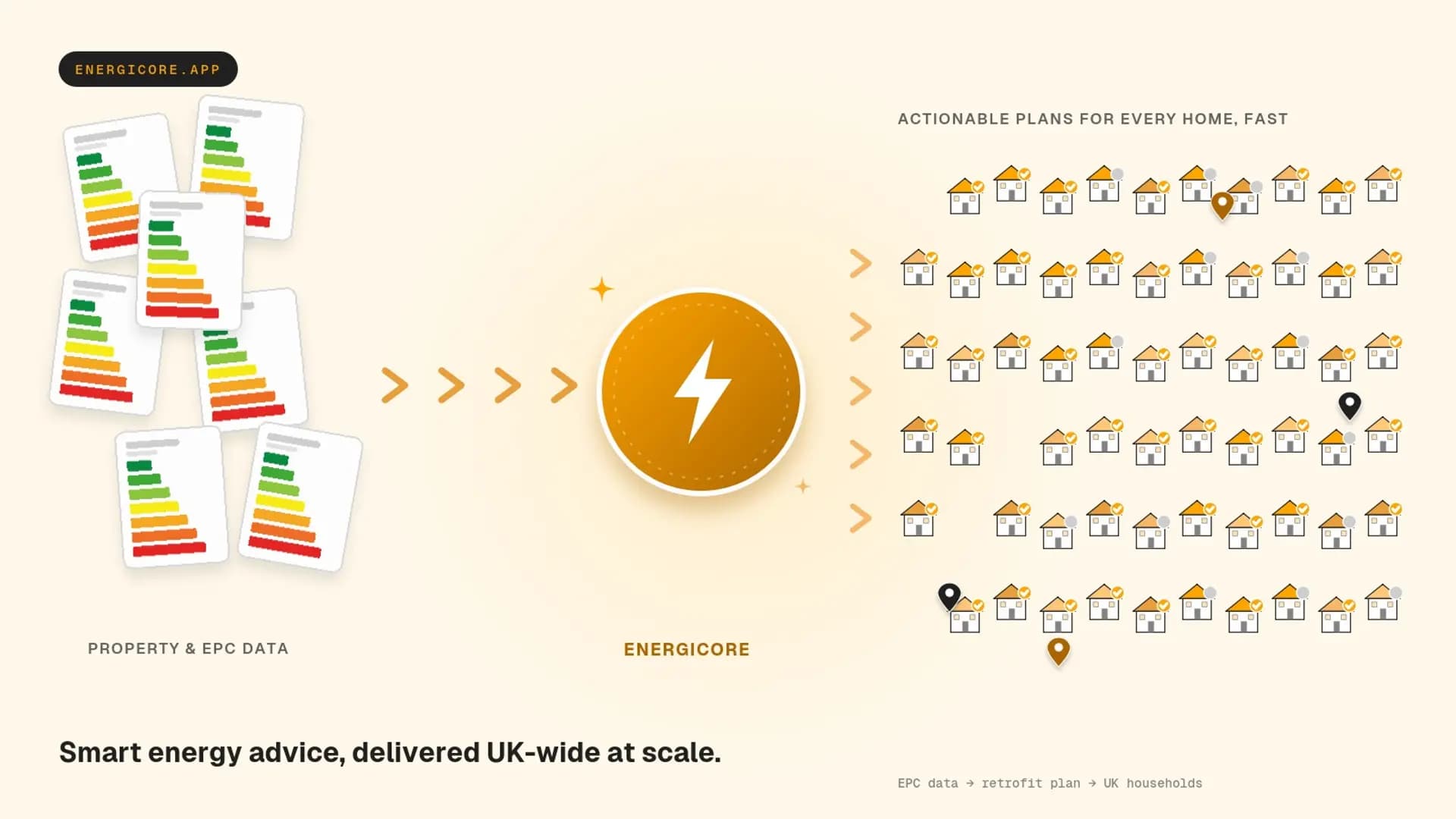
Energicore is a purpose built, ever evolving, smart energy advice platform designed to deliver actionable domestic energy advice at scale.