The LA Flex Postcode Lottery
The ECO4 La Flex Postcode Lottery: Why Your Council May Be Blocking Your £20,000 Home Grant
Share this article
Don't keep this knowledge to yourself!
Audio Version Available
Listen to this article while you multitask
The Great LA Flex Postcode Lottery
It is April 2026, and the United Kingdom is currently in the grip of what can only be described as ‘Retrofit Fever’. As we hurtle toward the newly minted 31st December ‘cliff edge’ for the ECO4 scheme, the desperation among homeowners is palpable. But beneath the shiny surface of government promises and net-zero targets lies a jagged, unfair reality: the LA Flex Postcode Lottery.
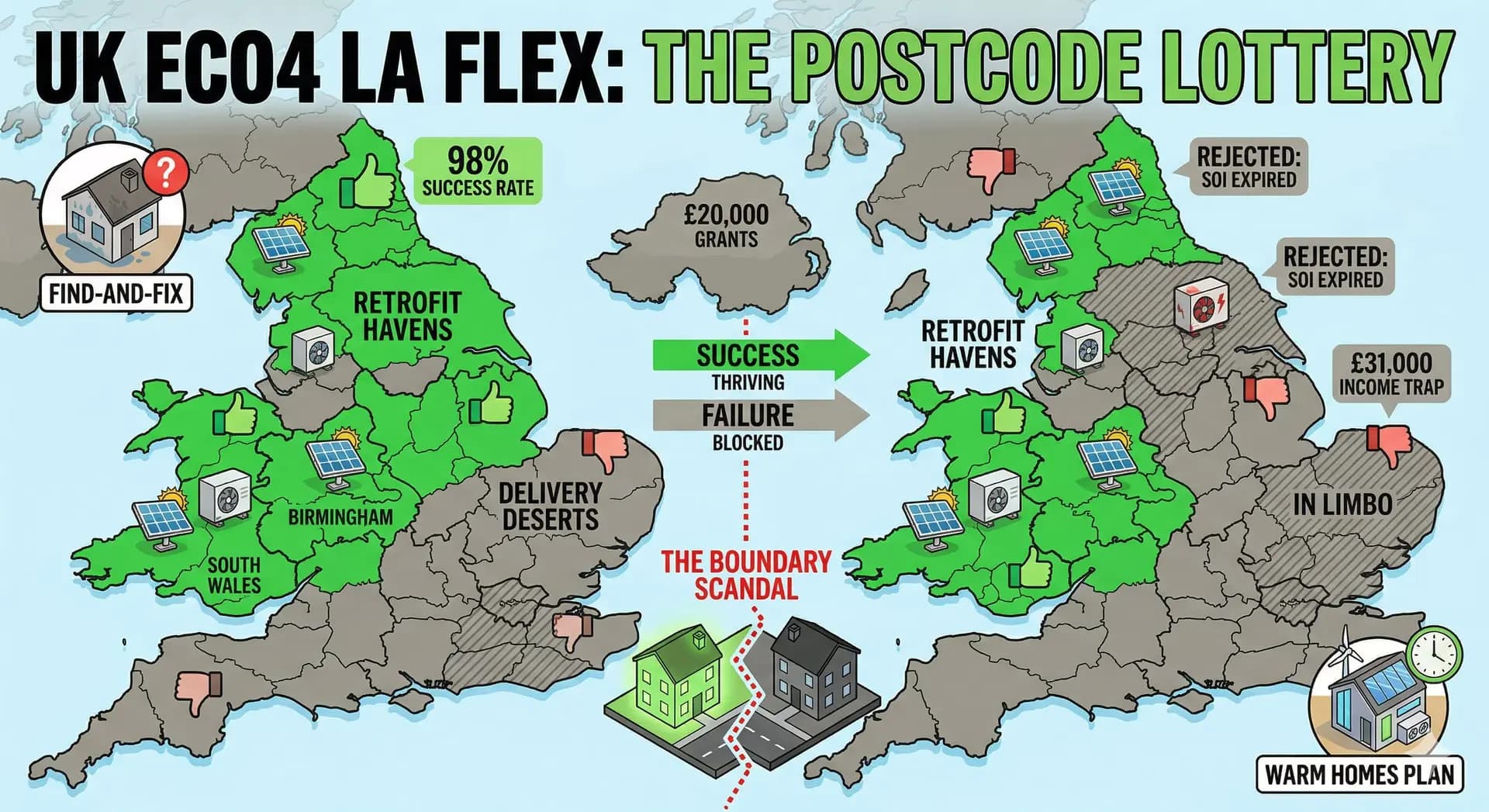
If you live on the ‘wrong’ side of a municipal boundary, you aren’t just missing out on a few energy-saving tips. You are potentially losing out on upwards of £20,000 in free home upgrades - solar panels, air-source heat pumps, and high-spec insulation—while your neighbour, three doors down but under a different local authority, is currently watching an installation team transform their home for free.
This isn’t just a bureaucratic quirk; it’s a national scandal.
The ‘Statement of Intent’ Standoff
To understand the chaos, we have to look at the mechanism of Local Authority Flexible Eligibility (LA Flex). Under the ECO4 scheme, energy suppliers are permitted to deliver up to 50% of their obligation through ‘Flex’ routes. This was designed to catch the ‘missing middle’ - households who don’t claim benefits but are still struggling with high energy costs or living in fuel-poor conditions.
On paper, it’s a brilliant safety net. In practice, it has devolved into a chaotic ‘Wild West’ where your eligibility is determined not by your bank balance, but by the competence and political will of your local town hall.
For a council to participate, they must publish a Statement of Intent (SOI). As of today, in early 2026, we are seeing a mass expiration of these documents. While central government extended ECO4 to December 2026 to allow for ‘find-and-fix’ remediation of faulty installations, many councils haven't updated their SOIs to match the extension.
The result? In ‘Retrofit Havens’ like Birmingham or parts of South Wales, the gates are wide open. In ‘Delivery Deserts’ across the Home Counties, the gates are padlocked. You could be a struggling pensioner in a draughty Victorian terrace, but if your council hasn't signed the paperwork, you are effectively invisible to the energy companies.
Major point to note : Although we are pointing out that LA Flex is a lottery, it's absolutely worth mentioning that even if a property was in a local authority which was still offering LA Flex routes that you'd still struggle to get anything installed because of the total mess the Labour government have left ECO4 in!
The Arbitrary Threshold: £31,000 or Bust?
The most glaring disparity lies in how councils interpret the Route 1: Low Income criteria. The national guidance suggests a household income threshold of £31,000. However, in 2026, with the cost-of-living crisis still casting a long shadow, £31,000 in London is ‘survival mode’, while in parts of the North East, it is relatively comfortable.
Some progressive councils have lobbied for ‘Route 4’ bespoke criteria, allowing them to adjust for local housing costs or specific demographic needs. Others have stubbornly stuck to the rigid £31,000 limit, refusing to acknowledge that a family of five earning £32,000 is often in a more precarious position than a single person earning £29,000.
The Bitter Reality: We are seeing reports of ‘boundary-hopping’ installers who refuse to even take calls from certain postcodes because the local council’s administration is too slow or their criteria are too restrictive. If you’re in a ‘difficult’ council area, you are essentially blacklisted by the supply chain, and who can blame them given the total mess ECO is in right now!
The Proxy Problem: The Great Logic Puzzle
Then we have the Proxies (Route 2). To qualify this way, a household must meet two ‘proxies’ - for example, living in an area of high deprivation and having a health condition made worse by the cold.
The ‘Postcode Lottery’ here is mind-boggling. Some councils allow a combination of ‘Council Tax Band A–D’ and ‘High Energy Debt’. Others have decided that Council Tax bands aren't a reliable indicator and have struck them from their SOI entirely.
Imagine the scene: You have a heart condition (Proxy 3) and you live in a Band D home. In Council A, you're a ‘Yes’. In Council B, across the street, they don’t recognise Band D as a proxy for ECO4 anymore. You stay in the cold; your neighbour gets a new heating system. It's a logic puzzle where the prize is a warm home, and the rules are written in disappearing ink.
The ‘Find-and-Fix’ Shadow
Adding fuel to this fire is the ongoing ‘Find-and-Fix’ crisis. As recently revealed in a scathing parliamentary report, approximately 30,000 homes fitted with external wall insulation (EWI) under earlier ECO phases are now being flagged for catastrophic defects.
The frenzy here is two-fold. Firstly, councils that were ‘high achievers’ in 2023–2024 are now finding that a huge percentage of their EWI installations are potentially failing due to poor oversight or ‘cowboy’ contractors. This has led many local authorities to ‘freeze’ new LA Flex approvals out of pure fear. They don't want to be the next headline in a damp-and-mould scandal.
Secondly, the resources that should be going toward new LA Flex applicants are being diverted into the remediation of these 30,000 ‘damp traps’. The industry is effectively cannibalising itself, fixing the mistakes of the past with the money meant for the future. For the homeowner currently applying via LA Flex, this means longer wait times, fewer available installers, and a sense that they are being shunted to the back of the queue.
The Installer’s Nightmare
We must also spare a thought for the installers, the boots on the ground. For a national retrofit company, operating across 300+ local authorities is an administrative suicide mission.
Every council has a different application portal, a different ‘processing fee’ (which can range from zero to £500), and a different turnaround time. We’ve seen installers go bust simply waiting for a council to sign off on a batch of LA Flex applications that were submitted six months prior.
Note : The figure of £500 processing fee is a figure we have simply heard about, so not actually confirmed as such. However, if any UK council is really charging £500 then they need investigating because that is just daylight robbery against installers!!
This administrative friction has created ‘Retrofit Monopolies’. Large installers will only work with ‘Easy’ councils. If you live in an area with a ‘Difficult’ council, you won't just struggle to qualify—you won't even find an installer willing to fill out the paperwork understandably.
The Looming ‘Warm Homes Plan’
As we look toward the transition to the Warm Homes Plan—the government's billion-pound successor to ECO4, the ‘Postcode Lottery’ is the elephant in the room. The government promises a ‘broader, more centralised approach’, but the industry remains sceptical.
Will the Warm Homes Plan actually fix the boundary lines, or will it just be the same lottery with a different name? The frenzy isn't just about the current inequality; it's about the fear that we are about to bake these systemic failures into the next decade of UK energy policy.
Conclusion: A Call for Consistency
The UK cannot meet its net-zero targets by 2050 if the road there is paved with such blatant unfairness. The ECO4 LA Flex scheme was intended to be a flexible tool for local needs, but it has become a barrier to progress for those who need help the most.
We need:
National Standardisation: A single set of income and proxy criteria that applies from Cornwall to Cumbria.
A Unified Portal: One application point for all UK councils to remove the administrative ‘red tape’ on installers.
Transparency: A public ‘League Table’ of council performance, showing exactly which local authorities are blocking progress and which are helping their residents.
Until then, the advice to homeowners remains the same: Check your postcode, check your council’s SOI, and pray you live on the ‘right’ side of the street. Because in the 2026 ECO4 frenzy, your geography is your destiny.